Urban Immovable Property Tax Act 1958 Pdf File
. Georgism, also called geoism and single tax (archaic), is an economic philosophy holding that, while people should own the value they produce themselves, economic value derived from (including and ) should belong equally to all members of society. Developed from the writings of the economist and social reformer, the Georgist paradigm seeks solutions to and problems, based on principles of land rights and public finance which attempt to integrate with. Georgism is concerned with the distribution of caused by, and the control of, including of ownership for and other contrived (e.g., ). Any natural resource which is inherently limited in can generate, but the classical and most significant example of 'land monopoly' involves the extraction of common from valuable urban locations. Georgists argue that taxing economic rent is, and. The main Georgist policy recommendation is a tax assessed on land value.
Georgists argue that revenues from a (LVT) can be used to reduce or eliminate existing taxes (for example, on, or ) that are unfair and inefficient. Some Georgists also advocate for the return of surplus public revenue back to the people by means of a.
Economists since have observed that, unlike other taxes, a public levy on land value does not cause. A land value tax also has effects, in that it is paid primarily by the wealthy (the landowners), and it cannot be passed on to tenants, workers, or users of land. Advocates of land value taxes argue that it would reduce, increase economic efficiency, remove incentives to under-utilize urban land, and reduce.
The philosophical basis of Georgism dates back to several early thinkers such as, and, but the concept of gaining public revenues mainly from land and natural resource privileges was widely popularized by Henry George and his first book, (1879). Georgist ideas were popular and influential during the late 19th and early 20th century. Political parties, institutions and communities were founded based on Georgist principles during that time. Early devotees of Henry George's economic philosophy were often termed Single Taxers for their political goal of raising public revenue mainly from a land value tax, although Georgists endorsed multiple forms of rent capture (e.g., ) as legitimate. The term Georgism was invented later, and some prefer the term geoism to distinguish their beliefs from those of Henry George. See also: is best known for popularizing the argument that government should be funded by a rather than.
George believed that although could not be performed in political economy, theories could be tested by comparing different societies with different conditions and by about the effects of various factors. Applying this method, he concluded that many of the problems that beset society, such as poverty, inequality, and economic booms and busts, could be attributed to the private ownership of the necessary resource, land. In his most celebrated book, George argues that the appropriation of land for private use contributes to persistent poverty in spite of technological progress, and causes economies to exhibit a tendency toward boom and bust cycles. According to George, people justly own what they create, but that natural opportunities and belong equally to all.
The tax upon land values is, therefore, the most just and equal of all taxes. It falls only upon those who receive from society a peculiar and valuable benefit, and upon them in proportion to the benefit they receive. It is the taking by the community, for the use of the community, of that value which is the creation of the community. It is the application of the common property to common uses. When all rent is taken by taxation for the needs of the community, then will the equality ordained by Nature be attained.
No citizen will have an advantage over any other citizen save as is given by his industry, skill, and intelligence; and each will obtain what he fairly earns. Then, but not till then, will labor get its full reward, and capital its natural return. — Henry George, Progress and Poverty, Book VIII, Chapter 3 George believed there was an important distinction between common and collective property.
Although equal rights to land might be achieved by nationalizing land and then leasing it to private users, George preferred taxing and leaving the control of land mostly in private hands. George's reasoning for leaving land in private control and slowly shifting to land value tax was that it would not penalize existing owners who had improved land and would also be less disruptive and controversial in a country where land titles have already been granted. Georgists have observed that privately created wealth is socialized via the tax system (e.g., through income and sales tax), while socially created wealth in land values are privatized in the price of land titles and bank mortgages. The opposite would be the case if land rents replaced taxes on labor as the main source of public revenue; socially created wealth would become available for use by the community, while the fruits of labor would remain private. According to Georgists, a land value tax can be considered a user fee instead of a tax, since it is related to the market value of socially created locational advantage, the privilege to exclude others from locations.
Assets consisting of commodified privilege can be considered as wealth since they have exchange value, similar to. A land value tax, charging fees for exclusive use of land, as a means of raising public revenue is also a tending to reduce, since it applies entirely to ownership of valuable land, which is correlated with income, and there is generally no means by which landlords can shift the onto tenants or laborers. Economic properties. Standard theory suggests that a land value tax would be extremely efficient – unlike other taxes, it does not reduce economic productivity. Described Henry George's tax on unimproved value of land as the 'least bad tax', since unlike other taxes, it would not impose an excess burden on economic activity (leading to zero or even negative '); hence, a replacement of other more distortionary taxes with a land value tax would improve economic welfare. As land value tax can improve the use of land and redirect investment toward productive, non-rentseeking activities, it could even have a negative deadweight loss that boosts productivity.
Because land value tax would apply to foreign land speculators, the Australian Treasury estimated that land value tax was unique in having a negative marginal excess burden, meaning that it would increase long-run living standards. It was Adam Smith who first noted the efficiency and distributional properties of a land value tax in his book,: Ground-rents are a still more proper subject of taxation than the rent of houses. A tax upon ground-rents would not raise the rents of houses.
It would fall altogether upon the owner of the ground-rent, who acts always as a monopolist, and exacts the greatest rent which can be got for the use of his ground. More or less can be got for it according as the competitors happen to be richer or poorer, or can afford to gratify their fancy for a particular spot of ground at a greater or smaller expense. In every country the greatest number of rich competitors is in the capital, and it is there accordingly that the highest ground-rents are always to be found. As the wealth of those competitors would in no respect be increased by a tax upon ground-rents, they would not probably be disposed to pay more for the use of the ground. Whether the tax was to be advanced by the inhabitant, or by the owner of the ground, would be of little importance.
The more the inhabitant was obliged to pay for the tax, the less he would incline to pay for the ground; so that the final payment of the tax would fall altogether upon the owner of the ground-rent. Both ground-rents and the ordinary rent of land are a species of revenue which the owner, in many cases, enjoys without any care or attention of his own. Though a part of this revenue should be taken from him in order to defray the expenses of the state, no discouragement will thereby be given to any sort of industry.
The annual produce of the land and labour of the society, the real wealth and revenue of the great body of the people, might be the same after such a tax as before. Ground-rents and the ordinary rent of land are, therefore, perhaps, the species of revenue which can best bear to have a peculiar tax imposed upon them.
Nothing can be more reasonable than that a fund which owes its existence to the good government of the state should be taxed peculiarly, or should contribute something more than the greater part of other funds, towards the support of that government. And made similar distributional and efficient arguments for taxing land rents. They noted that the costs of taxes and the benefits of public spending always eventually apply to and enrich, respectively, the owners of land. Therefore, they believed it would be best to defray public costs and recapture value of public spending by applying public charges directly to owners of land titles, rather than harming public welfare with taxes assessed against beneficial activities such as trade and labor.
Henry George wrote that his plan for a high land value tax would cause people 'to contribute to the public, not in proportion to what they produce. But in proportion to the value of natural common opportunities that they hold monopolize'.
He went on to explain that 'by taking for public use that value which attaches to land by reason of the growth and improvement of the community', it would, 'make the holding of land unprofitable to the mere owner, and profitable only to the user'. A high land value tax would discourage speculators from holding valuable natural opportunities (like urban real estate) unused or only partially used.
See also: and Income flow resulting from payments for restricted access to natural opportunities or for contrived privileges over geographic regions is termed. Georgists argue that economic rent of land, legal, and should accrue to the community, rather than private owners. In economics, ' is everything that exists in nature independent of human activity.
George explicitly included climate, soil, waterways, mineral deposits, laws/forces of nature, public ways, forests, oceans, air, and solar energy in the category of land. While the philosophy of Georgism does not say anything definitive about specific policy interventions needed to address problems posed by various sources of economic rent, the common goal among modern Georgists is to capture and share (or reduce) rent from all sources of natural monopoly and legal privilege. Henry George shared the goal of modern Georgists to socialize or dismantle rent from all forms of land monopoly and legal privilege. However, George emphasized mainly his preferred policy known as, which targeted a particular form of unearned income known as.
George emphasized ground-rent because basic locations were more valuable than other monopolies and everybody needed locations to survive, which he contrasted with the less significant streetcar and telegraph monopolies, which George also criticized. George likened the problem to a laborer traveling home who is waylaid by a series of highway robbers along the way, each who demand a small portion of the traveler's wages, and finally at the very end of the road waits a robber who demands all that the traveler has left. George reasoned that it made little difference to challenge the series of small robbers when the final robber remained to demand all that the common laborer had left.
George predicted that over time technological advancements would increase the frequency and importance of lesser monopolies, yet he expected that ground rent would remain dominant. George even predicted that ground-rents would rise faster than wages and income to capital, a prediction that modern analysis has shown to be plausible, since the supply of land is fixed. Common ground rent is still the primary emphasis of Georgists because of its large value and the known diseconomies of misused land.
However, there are other sources of rent that are theoretically analogous to ground-rent and are debated topics of Georgists. The following are some sources of economic rent.
Whose writings and advocacy form the basis for Georgism. Georgist ideas heavily influenced the politics of the early 20th century. Political parties that were formed based on Georgist ideas include the United States, the, the, and Denmark's. In the during 1909, the Liberal Government included a land tax as part of several taxes in the intended to redistribute wealth (including a progressively graded income tax and an increase of inheritance tax). This caused a crisis which resulted indirectly in reform of the.
The budget was passed eventually—but without the land tax. In 1931, the minority Labour Government passed a land value tax as part III of the 1931 Finance act. However, this was repealed in 1934 by the before it could be implemented.
In, the Georgist has previously been represented in. It formed part of a centre-left government 1957–60 and was also represented in the 1978–79. The influence of Henry George has waned over time, but Georgist ideas still occasionally emerge in politics. In the, mentioned Henry George in his policy statements. Economists still generally favor a land value tax. Publicly endorsed the Georgist land value tax as the 'least bad tax'.
Stated that: 'Not only was Henry George correct that a tax on land is non-distortionary, but in an equilibrium society tax on land raises just enough revenue to finance the (optimally chosen) level of government expenditure.' He dubbed this proposition the. Communities Several communities were also initiated with Georgist principles during the height of the philosophy's popularity. Two such communities that still exist are, which was founded in 1900 by and, and, which was founded in 1894 by the auspices of the. Some established communities in the United States also adopted Georgist tax policies.
A Georgist in Houston, Texas, promoted a Georgist club in that city established in 1890. Years later, in his capacity as a city alderman, he was selected to serve as Houston Tax Commissioner, and promulgated a 'Houston Plan of Taxation' in 1912. Improvements to land and merchants' inventories were taxed at 25 percent of appraised value, unimproved land was taxed at 70 percent of appraisal, and personal property was exempt. This Georgist tax continued until 1915, when two courts struck it down as violating the Texas Constitution in 1915.
This quashed efforts in several other Texas cities which took steps towards implementing the Houston Plan in 1915: Beaumont, Corpus Christi, Galveston, San Antonio, and Waco. The German protectorate of the in Jiaozhou Bay, China fully implemented Georgist policy. Its sole source of government revenue was the land value tax of six percent which it levied in its territory. The German government had previously had economic problems with its African colonies caused. One of the main reasons for using the land value tax in Jiaozhou Bay was to eliminate such speculation, which the policy achieved.
The colony existed as a German protectorate from 1898 until 1914, when seized by Japanese and British troops. In 1922 the territory was returned to China. Henry George School of Social Science in New York Georgist ideas were also adopted to some degree in, and. In these countries, governments still levy some type of land value tax, albeit with exemptions. Many municipal governments of the US depend on real as their main source of revenue, although such taxes are not Georgist as they generally include the value of buildings and other improvements. One exception is the town of, which for a time in the 21st century only taxed land value, phasing in the tax in 2002, relying on it entirely for tax revenue from 2011, and ending it 2017; the noted that 'Altoona is using LVT in a city where neither land nor buildings have much value'.
Institutes and organizations Various organizations still exist that continue to promote the ideas of Henry George. According to, the periodical, established in 1894, is 'the longest-lived Georgist project in history'. Founded during the in 1932, the Henry George School of Social Science in New York offers courses, sponsors seminars, and publishes research in the Georgist paradigm. Also in the US, the Lincoln Institute of Land Policy was established in 1974 based on the writings of Henry George. It 'seeks to improve the dialogue about urban development, the built environment, and tax policy in the United States and abroad'.
The continues to promote the ideas of Henry George in the UK. Is an international umbrella organisation that brings together organizations worldwide that seek land value tax reform. Reception The economist believed that George's views in were dangerous, even predicting wars, terror, and economic destruction. Specifically, Marshall was upset about the idea of rapid change and the unfairness of not compensating existing landowners. In his lectures on Progress and Poverty, Marshall opposed George's position on compensation while fully endorsing his ultimate remedy. So far as land value tax moderately replaced other taxes and did not cause the price of land to fall, Marshall supported on economic and moral grounds, suggesting that a three or four percent tax on land values would fit this condition.
After implementing land taxes, governments would purchase future land values at discounted prices and take ownership after 100 years. Marshall asserted that this plan, which he strongly supported, would end the need for a tax collection department of government. For newly formed countries where land was not already private, Marshall advocated implementing George's economic proposal immediately. Considered the Single Tax platform as a regression from the transition to and referred to Georgism as 'Capitalism’s last ditch'. Marx argued that, 'The whole thing is. Simply an attempt, decked out with, to save capitalist domination and indeed to establish it afresh on an even wider basis than its present one.' Marx also criticized the way land value tax theory emphasizes the value of land, arguing that, 'His fundamental dogma is that everything would be all right if ground rent were paid to the state.'
Georgists such as (2003) replied to these Marxist objections., known as the 'Father of Land Economics'agreed with the economic arguments for Georgism but believed that correcting the problem the way Henry George wanted (without compensation) was unjust to existing landowners. In explaining his position, Ely wrote that 'If we have all made a mistake, should one party to the transaction alone bear the cost of the common blunder?' Supported Georgist economics, but opposed what he perceived as an environmentally and politically reckless tendency for advocates to rely on a one-size-fits-all approach to tax reform, specifically, the 'single tax' framing. Commons concluded The Distribution of Wealth, with an estimate that 'perhaps 95% of the total values represented by these millionnaire sic fortunes is due to those investments classed as land values and natural monopolies and to competitive industries aided by such monopolies', and that 'tax reform should seek to remove all burdens from capital and labour and impose them on monopolies'.
However, he criticized Georgists for failing to see that Henry George's anti-monopoly ideas must be implemented with a variety of policy tools. He wrote, 'Trees do not grow into the sky—they would perish in a high wind; and a single truth, like a single tax, ends in its own destruction.' Commons uses the natural soil fertility and value of forests as an example of this destruction, arguing that a tax on the in situ value of those depletable natural resources can result in overuse or over-extraction. Instead, Commons recommends an income tax based approach to forests similar to a modern Georgist.
Revenue Department has very close interaction with the general public. Every individual has to approach Revenue Offices frequently for various requirements. The functions of this Department include. 1.
Issuance of various certificates for general public purposes. 2. Collection of Basic tax, Plantation tax, Building tax etc,. 3. Effecting Revenue Recovery. 4. Maintenance and updation of land records.
5. Conduct Elections including revision of electoral rolls and issuance of photo identity cards for the purpose of voting. 6.
Assignment of Government land to various categories. 7. Acquisition of land for public purpose. Conservation of Government lands and trees. Implementation of calamity relief operations and disbursement of funds to eligible persons.
10.Disbursement of Chief Ministers Distress Relief Fund to the needy. Issuance of arms licence, explosive licence, etc. Implementation of MPLADS and various other developmental schemes. 13. Redressal of public grievances.
14. Mplementation of various pension schemes. 15.
Implementation of various housing schemes. 16. Management and control of natural resources, regulation of sand mining,etc. 17. Conduct of census operations. 18. Transfer of government lands between departments.
Security proceedings under Criminal Procedure code. 20. Maintain Law and Order. 21. Removal of public Nuisance. Lease of Government land.
23. Survey and demarcation of land. 24.
Issuing death compensation to the legal heirs of NRIs. 25. Sanctioning of burning and burial grounds ORGANISATIONAL STRUCTURE OF THE DEPARTMENT. The Department is under the control of the Revenue Minister. In Secretariat, the department is headed by the Principal Secretary (Revenue Secretary) who is assisted by Additional Secretaries/ Joint Secretaries. The Revenue Department is headed by Land Revenue Commissioner who is assisted by Additional Commissioner and Assistant Commissioners.
The State of Kerala consist of 14 districts, 21 Revenue Divisions, 63 Taluks and 1532 Villages(or 1634 including group villages). Each district is headed by a District Collector who is assisted by Deputy Collectors among others. Each revenue division is headed by a Revenue Divisional Officer and assisted by Senior Superintendent among others. Each Taluk is headed by a Tahsildar and Additional Tahsildar who is assisted by Deputy Tahsildar among others. Each Village is headed by a Village Officer who is assisted by Special Village Officer, Village Assistant and Village man. The Director of Survey and Land Records at Thiruvananthapuram is in-charge of Survey operations and updation of land records and is assisted by Additional Director, Joint Directors, Assistant Directors among others. Each district Office is headed by an Assistant Director.
Land Board Land Board, Thiruvananthapuram is headed by Land Revenue Commissioner who is also the State Land Board and assisted by secretary for disposal of land ceiling cases under Kerala Land Reforms Act. This district has Taluk Land boards headed by Revenue Divisional Officers/ Deputy Collectors.
Institute of Land and Disaster Management. The land Revenue Department was in existence even before India became independent in 1947.
Revenue Department was in existence in the erstwhile Princely states of Travancore, Cochin, and also the Malabar region which was part of the Madras Provinces. The Revenue administration got special attention during the reign of Marthanda Varma. Marthanda Varma entrusted the work of settlement of lands, both wet and dry to Mallan Sankaran of Palliyadi. Preparation of land records or ozhuku containing survey number, name and extent of property, number of yielding trees, name and address of the assignee etc, is one of the most important works connected with Settlement. There are Vilangipper records which give additional information on Ozhukus. The classification of lands was done under the main heads of Devaswom, Brahmaswom, Danam and Pandaravaka was introduced by Mallan Sankaran. The double crop lands were assesses at twice the pattom for single crop lands.
Every landholder was given a patta specifying the tax levied on each item of land. The state establishment had a Valiya Sarvadhikaryakkar (Prime Minister), Neettezhuthu Pillai (Secretary), Melezhuthu Pillai (Head Accountant), Rayasam Pillai (Head Clerk) and several Rayasams and Kanakku Pillais (Clerks and Accountant).
During the first revenue settlement each division or district in the state was divided into taluks called Mandapathuvatukkals which was further subdivided into Kelvis or villages. The Mandapathuvathukkal was under a Karyakkar and the kelvi under the parvathikar. The Karyakar and the Parvathikar have evolved into the present day Tahsildar and the village officer respectively.
Ayilyam Tirunal (1860-1880) who succeeded Swati Tirunal got the services of Sir.T.Madhava Rao as Diwan till 1872. The beginning of agrarian reforms in Travancore started with the reign of Ayilyam Tirunal. The Pandarapattam proclamation of 1865 enfranchised all Sirkar Pattam lands and made them heritable and transferable.
The Janmi Kudiyan Proclamation of 1867 provided for fixity of tenure of the tenant. A comprehensive survey and settlement of the lands was conducted in Visakam Tirunal's (1880-1885) regime. Land reforms got a fillip under the next ruler Sree Mulam Thirunal (1885-1924). The settlement process which begun during the previous regime was completed with the settlement proclamation in 1886.
Consequent on the re- organization of states, Kerala State was formed on 1.11.1956 integrating Travancore- Cochin and Malabar areas. Different set of Laws, Rules and procedures were in existence in Travancore, Cochin and Malabar and the administrative set up was also different. Unified Laws, Rules and Regulations were framed after 1.11.1956. The Department of Treasuries and Civil Supplies were part of the Revenue Department in the past. Later on, a separate department of Treasuries was formed in the year 1963 and Department of Food and Civil Supplies formed in the year 1975. INTEGRATION The Village Establishment and the Revenue Establishment were two distinctive services in the Revenue Department.
Separate set of Rules governing the services of Village staff and Revenue staff were in existence. In the year 1984, the Village and Revenue services were integrated and a common Revenue service was formed. Lower Division Clerks and Village Assistants were integrated into one common unit and Upper Division Clerks and the Village Officers were integrated as another common unit. Unified Rules governing the services of various other categories were also framed. ABOLITION OF BOARD OF REVENUE The Head of the Department in respect of the Revenue Department was the Board of Revenue and the Revenue hierarchy consisted of Secretary Board of Revenue, District Collectors, Revenue Divisional Officers, Tahsildars, Firka Revenue Inspectors and Village Officers. The Revenue Board was abolished with effect from 1.7.1998 and instead a Commissionerate of Land Revenue was formed.
In the place of Member, Board of Revenue, Commissioner, Land Revenue was appointed. The post of secretary, Board of Revenue was re-designated as Additional Commissioner (LR). The posts of the Assistant Secretaries were re-designated as Assistant Commissioners. The post of Firka Revenue Inspectors was abolished and the post of village Officers were upgraded to that of the Head Clerk/ Revenue Inspector and one post of Additional Tahsildar in each Taluk was also newly created. Line departments, Institutions and organizations under the department. Land Revenue Department.
Directorate of Survey and Land Records. Land Board. Disaster Management Authority Kerala suffered a series of natural disasters since the Tsunami havoc in 2004. There was an unprecedented draught followed by floods, landslides and tremors.
The disasters continue in the form floods from summer rains this year. In the context of global warming and world climate change such disasters are likely to recur causing death and loss of property. This situation compelled Government to focus on disaster mitigation in a time bound and effective manner. So the government constituted the State Disaster Management Authority. Institute of Land and Disaster Management is an autonomous body constituted under the Revenue Department, Govt. Of Kerala to impart professional training, including induction training, in-service training and refresher training to personnel of the Land Revenue and Survey Department of Kerala State. 1 To impart professional training, including induction training, in-service training and refresher training to personnel of the Land Revenue and Survey Department of Kerala State 2 To impart and develop managerial and technical skills of the above personnel.
3 To undertake research and study projects relating to the aforesaid departments with a view to improve their functioning and productivity. 4 To function as a nodal agency for introducing new techniques of operation, innovations and modern technology. Administration Institute of Land and Disaster Management is an autonomous body constituted under the Revenue Department, Govt. Of Kerala and registered under the 'Travancore - Cochin Literary, Scientific and Charitable Societies Act, 1955'. 1 Governing Body 2 Executive Committee 3 Director 4 Any other committees appointed by the Governing Body.
The management of the society will, in accordance with its Rules, be vested in the Governing Body, consisting of the following members: 1 Chairman, Minister for Revenue. 2 Vice Chairman, Commissioner Land Revenue 3 Members: i) Secretary to Government, Revenue Department.
Ii) Secretary to Government, Finance Department iii) Director of Survey and Land Records. Iv) Director, IMG v) Director, ILM vi) District Collector, Thiruvananthapuram vii) Secretary to Government, Personnel & Administrative Reforms Department viii) Secretary to Government, Local Administration Department Executive Committee. Subject to the general superintendence of and the policies laid down by, the Governing Body, the Executive Committee shall be responsible for the management, administration and control of the affairs of the institute and its income and properties in accordance with these rules. Land Information Mission has been constituted for the purpose of carrying out the objectives of Bhoomi Keralam, the most ambitious project of Government of Kerala. Bhoomi Keralam is a time bound project for the completion of cadastral survey of the State using hybrid technology (aerial photogrammetry, GPS+ETS ground survey). The ultimate goal is to generate digital land records as GIS layers that would be permanently available over the web for easy verification by stake holders. The objectives of the mission include, finalising resurvey in the State within a period of three years, maintain updated records of all public lands, prepare survey records of 27,000 Hectares of land to be distributed to the Adivasis of the state in nearly 1000 locations, complete resurvey of 31 villages of Thiruvananthapuram taluk under the centrally sponsored National Land Records Modernisation Programme (NLRMP), complete the resurvey of land in the possession of M/s.
Harrison Malayalam Plantation limited and to identify excess land if any held by the company unauthorisedly, attend to survey of lands to be acquired for public purpose under special projects and on those objectives which may be directed by the Government, from time to time. For more information.
Major Functions of the department Administration of revenue has historically come to mean a lot of things. Although Revenue Department deals with issues related to land, maintenance of documents, protection of public land, collection of land revenue etc today the Department has to carry out a number of responsibilities. Right from the village offices to the District Collectorates, the Revenue Department is dealing with nearly 150 subjects concerning common man such as issuance of various certificates, maintenance of land records, collection of land revenue tax and cess, effecting revenue recovery, settling land survey disputes, land reforms, conduct of election process, handling of law and order situation, calamity relief and rehabilitation, disaster management and so on. In short the department is directly or indirectly involved in all situations of the day-to-day administration of the State. At the district level it coordinates activities of various departments and developmental programems of the State.
Statutes and Orders The Revenue Officials by virtue of this fact that the majority of their functions are governed by statutes have to necessarily acquaint themselves with nearly 140 and odd statutes in their capacities as the District Collectors or Sub Divisional Magistrates, the functionaries have to be familiar with some of the following Acts and Rules. Central Acts Indian Penal Code 1860 Prevention of Corruption Act 1947 Commissions of Inquiry Act 1952 Arms Act 1959.Act 1969 Code of Criminal Procedure 1973 National Security Act 1980 State Acts Kerala Police Act 1960 Kerala Enquiries and Summons Act 1960 Kerala Places of Public Resort Act 1963 Kerala Public Servants (Enquiries) Act 1963 Kerala Public Men's Corruption ( Investigation and Enquiries ) Act 1987 Revenue and other Laws Central Acts: Motor Vehicles Act 1939 Essential Commodities Act 1955 Citizenship Act 1955 State Acts 1. Cochin Abkari Acts 1077 and Disposal and Auction rules 2. Kerala Requisitioning and Acquisition of Immovable Property Act 1955 3. Kerala Board of Revenue Act 1957 4. Kerala Cinemas Regulation Act 1958 5. Kerala Stamp Act 1959 6.
Kerala Plantation (Additional Tax) Act 1960 7. Kerala Panchayati Raj Act 8.
Kerala Nagara Palika Act 9. Kerala Local Authorities Entertainment Tax Act 1961 10. Kerala Land Tax Act 1961 11. Kerala Forest Act 1961 12.
KGST Act 1963 13. Kerala Public Accountant Act 1963 14. Kerala Building (Lease and Rent Control) Act 1965 15.
Kerala Revenue Recovery Act1968 16. Kerala Private Forest (Vesting and Assignment Act 1971 17. Kerala Buildings Tax Act 1975 18. Kerala Agricultural Labourers Act 1975 Land Laws 1.
Kerala Land Conservancy Act 1957 2. Kerala Compensation for Tenants Improvement Acts 1958 3. Kerala Land Relinquishment Act 1958 4.
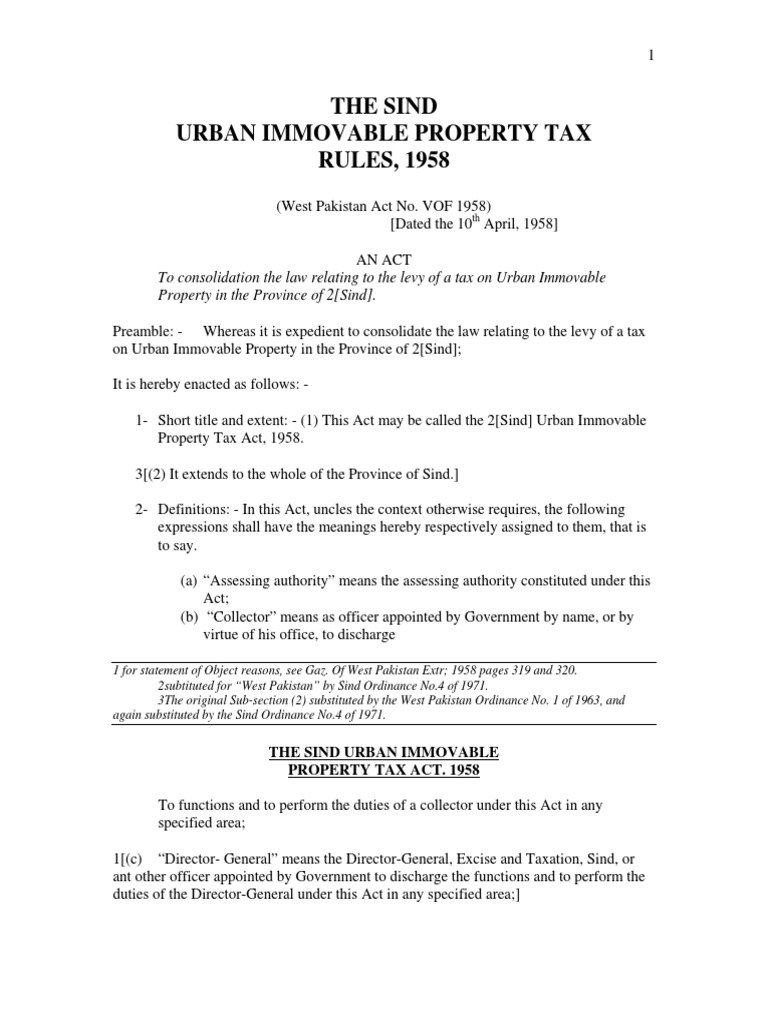
Urban Immovable Property Tax Act 1958 Pdf Files
Kerala Land Assignment Act 1960 5. Kerala Survey and Boundaries Act 1961 6.
Kerala Land Acquisition Act 1962 7. Kerala Land Reforms Act 1963 8. Kerala Land Development Act 1964 9.
The Treasure Trove Act 10. Escheats and Forfeiture Act Manuals. Travancore Land Revenue Manual. Cochin Land Revenue Procedure. Boards Standing Orders. Manual of Village Accounts. District Office Manual.
Manual of Office Procedure. Kerala Civil Services (Classification Control and Appeal) Rules 1960 1. Revenue (A) Department Phone: 04 1. Land Assignment, Transfer and Land Conservancey in respect of Pathanamthitta/Kottayam/Alappuzha/Idukki/Ernakulam District. Papers relating to Munnar issue. Revenue (B) Department Phone:0471- 2518207 1.
Kerala Land Acquisition Rules. Publishing of notification under section 4 (1) of Kerala Land Acquisition Act, Approval of declaration on Land Acquisition, withdrawal of notification except for Government of India Offices/Institutions and Airport Societies. Remarks and advice of land acquisition matters except for Government of India Offices/Institutions. Creation of special staff for Land Acquisition Units, its continuance and abolition. Rules on reconveyance of land under Kerala Land Acquisition Act. All suits and petitions on the subject dealt within ‘B' Section except for Government of India Offices/Institutions and Airport Societies.
Public Accounts Committee, Draft paras. Inspection Report and Audit Report of Accountant General. Satisfaction of devices and Judgements and issuance of sanction to file appeals in L.A.R. Cases by the DC's and papers relating to special L.A. Units in the Districts of Ernakulam, Thrissur, Palakkad, Malappuram, Wayanad, Kannur and Kasaragod. 10.Remission and write off, Kerala Recovery of Arrears of Jenmikaram Act, 1975. 11.Satisfaction of devices and Judgements and issuance of sanction file appeals in L.A.R.
Cases by the DC's and papers relating to special L.A. Units in the Districts of Thiruvananthapuram, Kollam, Pathanamthitta, Alappuzha, Kottayam and Idukki Districts except for Government of India Offices/Institutions and Airport Societies. Miscellaneous papers. Revenue (C) Department Phone: 04 1.
Establishment matters of Deputy Collectors. Movement of District Collectors. Liaison Officer and his Office at the Advocate General's Office (all papers).
Establishment and service matters of Tahsildars and Deputy Tahsildars and equivalent categories. Special Rules for the various posts in the Kerala Revenue Service and Revenue Subordinate Service. Establishment/Service matters relating to all posts under Revenue Ministerial Subordinate Service viz., L.D. Clerks/Village Assistant including Speical Village Assistants and Additional Village Assistants, Revenue Inspectors including Firka Revenue Inspectors and Special Revenue Inspectors, Head Clerks/Head Accountant and all other equivalent categories in the Land Revenue Department/Land Board.
Revenue (D) Department Phone: 0471-251 8963 1. Disciplinary cases (including allegation petitions/complaints etc.) against all categories of staff and officers in the Land Revenue Department and Land Board. Revenue (Devaswom) Department Phone: 04 1. Establishment/Service matters relating to all posts under Hindu Religious and Charitable Endowment (A) Department.
Disciplinary cases (including allegation petitions/complaints etc.) against all categories of staff and officers of Hindu Religious and Charitable Endowment (A) Department. Hindu Religious and Charitable Endowment Act and Rules. Malabar Temple Employees Welfare Fund Scheme. All Temples/Devaswoms under Hindu Religious and Charitable Endowment (A) Department. All Appeal Petitions/Revision Petitions of Hindu Religious and Charitable Endowment (A) Department. Annual Inspection and follow up on the Inspection Report of Hindu Religious and Charitable Endowment (A) Department.
Travancore Devaswom Board, Cochin Devaswom Board, Koodal Manickom Devaswom and Guruvayur Devaswom. Travancore-Cochin Hindu Religious Institutions Act. 10.Koodal Manickom Devaswom Act and Rules. 11.Guruvayur Deavswom Act and Rules. 12.Grant and Loans to Devaswom Boards.
Revenue (E) Department Ph: 04 1. Establishment and Service matters relating to Non-Gazetted Officers of Survey and Land Records Department (excluding papers relating to disciplinary proceedings, T. A., D.A., Leave, P.C.A.
And arrear claims). Survey Training Schools. Special Rules of Servey and Land Records Department. Employment assistance under scheme to dependents of all category of Survey and Land Records Department. Survey Training Programmes of Survey and Land Records Department.
Accountant General's Report on Survey and Land Records Department. Establishments and Service matters relating to Gazetted Officers of Survey and Land Records Department. Disciplinary proceedings relating to both Gazetted and Non-Gazetted Officers of Survey and Land Records Department. T.A., D.A., Leave, P.C.A. And arrear claims of both Gazetted and Non- Gazetted Officers.
10.Cardamom Hill Reserve Lands. Preparation of Administrative Report of the Survey and Land Records Department. Establishment of Revenue Administration Institute.
Training of Gazetted Officers of Survey and Land Records Department. 14.Kerala Survey and Boundaries Act and Rules. 15.Boundaries disputes received from land holders. 16.Joint verification of Inter state Boundary between Kerala and adjoining States.
17 Scheme of Re-survey of State. Purchase of Survey Stones, Survey equipments for Survey and Land Records Department. 19.Plan Scheme relating to Survey. 20.Restricted Maps.
21.Torrens System. 22.Transfer of Registry Acts and Rules. Revenue (F) Department Phone: 04 1. Formation/Delimitation of Districts/Taluks and Villages. Construction of Revenue Buildings.
Hiring of Private Buildings for Revenue Department Offices and connected papers. Budget of Land Revenue Department.
Kerala Wakf Board and papers relating to Wakf matters, Wakf Act and Rules, Adithoon Pension, Court of Wards Act. Free ration under CMDRF. State Name Authority and Centrally Sponsored Scheme.
Inspection Reports of Finance Department. Appropriation Accounts. Revenue (G) Department Phone: 04 1. Plantation Tax. Basic and Land Tax. Kerala Escheats and Forefeitures Act and Rules. Kerala Public Accounts Act.
Kerala Treasure Trove Act and Rules. Revenue Enquiry and Summons Act.
Board of Revenue Act and Rules. Printing of forms, Registers and supply of stationeries for the Offices under the Land Revenue Department and the Land Board. Purchase of furniture and other office equipments for the offices under the Land Revenue Department and the Land Board. 10.Purchase and repair of the vehicles of Land Revenue Department and the Land Board. 11.Installation of telephones in the Offices under the Land Revenue Department and the Land Board.
12.Office procedure of Board of Revenue (LR). 13.General Administration of Land Revenue Department and Collectors Conference. 14.Gathering of information and furnishing of consolidated replies relating to references receiving from other departments other than LA. Interpellation/Assurance. Office procedure of the Revenue Department.
Staff meeting of Revenue Department. Meeting of Revenue Secretary and other officials. Meeting of Minister (Revenue) and other officials of Revenue Department. Miscellaneous papers of the Revenue Department. Consolidation of Monthly Business Statement of Revenue Department.
Monthly Business Statement of Collectors. Revenue (H) Department Phone: 04 1. Papers relating to Revenue Recovery in respect of Palakkad, Malappuram and Wayanad Districts.
Issuing Stay Orders, Original Suits, Original Petitions, Suit Notices relating to Revenue Recovery. Papers relating to Revenue Recovery in respect of Kannur, Kasaragode, Kozhikode Districts. Issuing Stay Orders, Original Suits, Original Petitions, Suit Notices relating to Revenue Recovery. Papers relating to the Revision Petition filed u/s 83 (2) of KRR Act, 1968 of all Districts.
Papers relating to Kerala Revenue Recovery Act and Rules. Papers relating to DCB statements in respect of Revenue Recovery. Revenue Recovery Meetings. General Papers relating to Revenue Recovery. Papers on SLBC relating to Revenue Recovery. Draft Para/Audit Para.
Revenue (L) Department Phone:0471- 2518696 1. Assignment of land, Transfer and land conservancy cases of Palakkad and Malappuram Districts.
Pattayam pass book/Revenue card. Assignment of land, Transfer and land conservancy cases of Kannur, Kozhikode and Kasaragod Districts. Assignment of land, Transfer and land conservancy cases of Wayanad and Thrissur Districts. Revenue (N) Department Phone: 0471- 251 8241 1.

Kerala Land Reforms Act and Rules. Ceiling on Urban properties. Kudikidappukar's Benefit Fund and Kudikidappukar's Housing Scheme. Agriculturist Rehabilitation Fund. Reconstitution of Taluk Land Board. Reconstitution of Land Reforms Review Board.
The Bonds issued for compensation for excess lands. Committee on Subordinate Legislation of K.L.R. Purchase of Land lords right by cultivating tenants. Rehabilitation and welfare schemes to ex-landlords. 11.All suits under the K.L.R. Act and papers relating to the resumption of land under the K.L.R.
Act in respect of Thiruvananthapuram, Kollam, Pathanamthitta, Alappuzha, Kottayam, Ernakulam and Thrissur Districts. Alienation of surplus land in respect of Districts mentioned above. Petition from public for surplus land, against eviction, request for patta etc. In respects of above Districts. Transfer or Assignment of surplus land, to other departments or agencies in respect of above Districts. Request for exemption from ceiling provisions under section 81 (3) and section 98 (A) of K. Act, in respect of above Districts.
Implementation of ceiling provisions of K.L.R. Act, in respect of above Districts. Block Joint Farming Co-operative Societies. Petitions on surplus land before Committee on Petitions S.C. And S.T. Welfare Committee. Papers on Draft Para. All suits under the K.L.R.
Act and papers relating to the resumption of land under the K.L.R. Act in respect of Palakkad, Malappuram, Kozhikode, Wayanad, Kannur and Kasaragod Districts. Alienation of surplus land in respect of Districts mentioned above. Petitions from the public for surplus land, aganist eviction request for patta etc. In respect of above Districts. Transfer or Assignment of surplus land, to other departments or agencies in respect of above Districts.
Request for exemption from ceiling provisions under section 81 (3) and section 98 (A) of K.L.R. Act, in respect of above Districts. Request for compensation due for the excess land surrendered or taken over. Petitions on surplus land before Committee on Petitions S.C.
And S.T. Welfare Committee. Revenue (P) Department Phone: 0471-251 8103 1. Papers relating to Kerala Land Conservancy Act and Rules. Papers relating to Kerala Land Assignment Act and Rules. Papers relating to Kerala Pretection of River Banks and Regulation of Removal of Sand Act and Rules.
Interpellation of a general nature in respect of Land Assignment and Land Conservancy. Papers relating to Rules for the Lease of Lands. Papers relating to Land Assignment Committee under the KLA Rule. Papers on advisory nature received from other Departments on Assignment, Leases etc. Papers relating to the Kerala Conservation of Paddy Land and Wet Land Bill, 2007. Papers relating to the Kerala Fisherman Debt Relief Commission Bill, 2007 (Relating to Revenue Department).
Papers relating to setting up of Land Bank). Papers relating to Kerala State Land Policy. Papers relating to review of progress of Land Assignment. Papers relating of vested Forest Land Assignment. Papers relating to lands owned by the Government of Kerala outside the territorial limits of the State. Arable Forest Land Assignment Rules. Papers relating to Special Staff for land assignment work, District Land Assignment Committee under the Arable Forest Land Assignment Rule.
All Papers under KLA (Regulation of Occupants Prior to 1997. Papers relating to Assignment of Land to IIST under VSSC. Papers relating to eviction and rehabilitation of occupants from project areas. Papers relating to transfer of land to Municipalities and Corporations.
Papers relating to Janmikaram Payment (Abolition) Act, 1960 and Kerala Compensation or Tenancy Improvements Act. Papers relating to the Kerala Farmers' Debt Relief Commission Act and Rules. Miscellaneous papers of the section. Implementation of Kerala Protection of River Banks and Regulation of Removal of Sand Act and Rules.
Implementation of River Management Fund/Administrative Sanction. Revenue (R) Department Phone: 0471-251 7132 1.
Regular and Interim Annuity to Religious, Charitable and Educational Institutions of Public Nature under Kerala Land Reforms Act in respect of Thiruvananthapuram, Kollam, Pathanamthitta, Alappuzha, Kottayam, Ernakulam and Palakkad Districts. Plan Schemes on Centrally Sponsored Schemes regarding Land Reforms. Release of funds from Government of India for the assignees of surplus land under the Centrally Sponsored Scheme. Kanam Tenancy Act.
Review of fortnightly/monthly/quarterly progress report under the 20 Point Programme regarding financial assistance to the assignees of surplus land. Pattazhi Devaswom Lands (Vesting and enfranchisement) Act, 1961. Legislation of the Oodupally lands (Enfranchisement) Bill. Kerala Scheduled Tribes (Restriction as Transfer of Land and Restoration of Alienated Lands) Act, 1975. Monthly review of work of Land Tribunals under various sections of K. Public Accounts Committee, Inspection Reports, Draft Paras, Audit Report and Appropriation Accounts in respect of Land Board.
Review of Implementation of ceiling provisions of various matters under K. Review of quarterly statement of disposal of disciplinary cases relating to K.L.R. Kandukrishy Land Assignment Rules. Sreepandaravaka Lands (Vesting and Enfranchisement) Act. Bhoodan and Gramadan Movement.
Viruthy Rules. Thirappuvaram Payment (Abolition). Miscellaneous papers connected with the Taluk Land Board, Appellate Authorities, Land Board, Land Tribunals etc., other than the establishment matters of the personnel now dealt within Revenue ‘ C' or ‘D' Section. Section 75 (3) shifting of Kudikidappu of K.L.R. Act and the suit thereunder. Defence personnel relating to K.L.R.
Purchase of Kudikidappu right under section 75 to 80 of the K.L.R. Act. Regular and Interim Annuity to Religious Charitable Educational Institutions of Public nature under K.L.R. Act in respect of Thrissur, Malappuram, Kozhikode, Wayanad, Kannur and Kasaragod Districts. Kannan Devan Hills (Resumption of Lands ) Act and Rules. Assignment of Surplus land at Mankulam and Muthikkad.
Supply of Paddy and Rice to the Travancore Palace (Extinguishment Rights and Liabilities Bill, 1976). Kerala Stay of Eviction Proceedings Act, 1966 and 1968. Oodukkoor settlement proclamation. Record of Rights Act, 1968. Payment of Jenmibhagam Pension. Karathil Chilavu and Arthapalisa. Edavagai Rights Acquisition Act.
Sreepadam Lands Enforcement Act, 1969. Service Inam Land Enforcement. Revenue (S) Department Phone: 0471-251 8201 1. Revenue Recovery (Issuing of Stay Orders, Original Suits, Original Petitions, Suit Notices relating to Revenue Recovery). Revision Petition under section 83 (2) of Kerala Revenue Recovery Act. Amendment to Kerala Revenue Recovery Act and Rules.
Papers relating to D.C.R. Statement in respect of Revenue Recovery. Papers received from other Departments for advice and remarks on the provisions of the Kerala Revenue Recovery Act. General Papers relating to Revenue Recovery. Revenue (Special Cell) Department Phone: 0471-251 7180 1. Papers relating to solvency cases relating to Thiruvananthapuram, Kollam, Pathanamthitta, Alappuzha, Kottayam, Idukki and Ernakulam Districts, Miscellaneous papers and Building Tax relating to Thiruvananthapuram, Kollam, Pathanamthitta and Alappuzha Districts.
Papers relating to KBT Act, 1975 in respect of Palakkad, Malappuram, Kozhikkode, Wayanad, Kannur and Kasaragod Districts. Papers Relating to Kerala Building Tax Act, 1975 in respect of Kottayam, Idukki, Ernakulam and Thrissur Districts. Papers Relating to Draft Para, Audit Para And PAC Recommendations. Disciplinary Action against the Revenue Officers who involved in the issuance of Solvency Certificates in respect of Thrissur, Palakkad, Malappuram, Kozhikode, Wayanad, Kannur and Kasaragode Districts. Revenue (T) Department Phone: 0471- 2518234 1. Employment Assistance to Dependants of Government Servants under Compassionate Employment Scheme in Land Revenue Department and Land Board. Copyists, Drivers, Security, Watch and Ward Staff, Attenders, Last Grade Servants, Villageman and P.T.
Contingent employees and Land Revenue Department and Land Board now dealt within ‘D3' seat. Continuance sanction of posts of Land Board, Taluk Land Board Appellate Authorities and Land Tribunals and Land Revenue Department. Administration Report of Land Board. Arrear claims of Revenue Staff. Deputation and leave of all categories of staff and Officers in the Land Revenue Department and Land Board, including Establishment/ Service matters relating to Typists (L.D./U.D./Supervisory) and CA's.

Establishment matters relating to the posts of UDCs/Village Officers including Special Village Officers and Additional Village Officer. Delegation of powers. Revenue (U) Department Phone: 04 1.
Land Assignment, Transfer and Land Conservancy cases in respect of Thiruvananthapuram District. The Estate Committee.
Land Relinquishment Act and Rules. Land Assignment, Transfer and Land Conservancy cases in respect of Kollam District.
Transfer of Land to Panchayats. Revenue (PS) Department Phone:0471-251 8828 1. Receipts, Distribution, Consolidation and follow up action of papers of Legislative Assembly interpellations/Assurance concerned to the Revenue Department and matters on Wakf and Devaswom.
Liaison work between the Revenue Department and the Legislative Secretariat. Communicating and follow up action of papers relating to:— (1) Public Accounts Committee. (2) Petition Committee.
(3) Assurance Committee. (4) Subject Committee. (5) Estimates Committee.
(6) Committee on Subordinate Legislation. (7) Public Undertakings Committee.
(8) Scheduled Castes and Schedule Tribe Committee of the State Legislature. Watching over the disposal of papers relating to the Report of the comptroller and Auditor General. Compilation or Important Orders of Revenue Department. DISASTER MANAGEMENT DEPARTMENT 19. Disaster Management (Rev. K) Department Phone: 0471-251 8113 1 Natural calamities such as Flood, Sea erosion, Land slide etc., other than drought and fire.
Preparation of Memorandum on Flood. Central Assistance for flood relief measures and allied papers.
Relief operations on flood etc., other than drought and fire. The meeting of relief Commissioners. Famine Relief Works. Natural calamities (Drought) and fire.
Drought Relief Works. Preparation of Memorandum on Drought. Central Assistance for drought relief measures and allied papers. Prime Ministers National Relief Fund.
Preparation of Drought Manual. Personal Accident Insurance Social Security Scheme for the poor families (PASS).
Hut Insurance Scheme. State Level Committee meetings on the administration of Calamity Relief Fund.
Grand of financial assistance to the victims of Natural Calamities. Issue of free ration to the victims of Natural Calamities. Anti disaster scheme. Modification of rules relating to the Manual on relief on account of Natural calamities and Distress relief. Revenue (DRF-A) Department Phone: 0471-251 8513 1. Papers relating to CMDRF of Thiruvananthapuram/Kollam/Alappuzha/Pathanamthitta/Idukki/Kottayam/Ernakulam Districts.
General papers on CMDRF. Revenue (DRF- B) Department Phone: 0471-251 8487 1. Papers relating to CMDRF of Thrissur/Palakkad/Malappuram/Kozhikode/Wayanad/Kannur/Kasaragod Districts. Disaster Management (TRP-Cell) Department Phone: 04 1.
Prime Minister's National Relief Fund, Programme Management Unit,Maintenance of accounts of Programme Management Unit, Tsunami Emergency Assistance Project, Papers relating to Housing, Maharashtra Housing Scheme, District Level Monitoring Committee, Procurement of stationery and equipments for TRP Cell, Japan Poverty Fund for Rehabilitation. All general guidelines except Prime Minister's National Relief Fund, State Level Empowered Committee, Planning Commission, Location-wise Physical Financial Sectoral Programme, Release of Funds, TRP. General papers relating to Tsunami, Papers relating to Tsunami anniversary, writing off of loans, additional exgratia to family of Tsunami victims, General Petitions, Jankar Service, legal services authority, Comptroller and Auditor General Reports, Tusnami Museum, Miscellaneous papers.