Teraterm Script Serial Port
Serial configuration The standard setup for the USB Serial Port is 9600 baud, 8 bits, 1 stop bit, no parity (aka 9600-8-N-1) Windows users 1. Install a Terminal Application Download and install a Terminal application. In this example we recommend the latest version of Teraterm:. Other terminal applications are available:. Some Windows PCs come with 'Hyperterminal' installed; you can use this too, but we have found Tera Term is just a bit more friendly to use. Configure the Connection Open and Setup Teraterm. File - New Connection (or just press Alt+N).
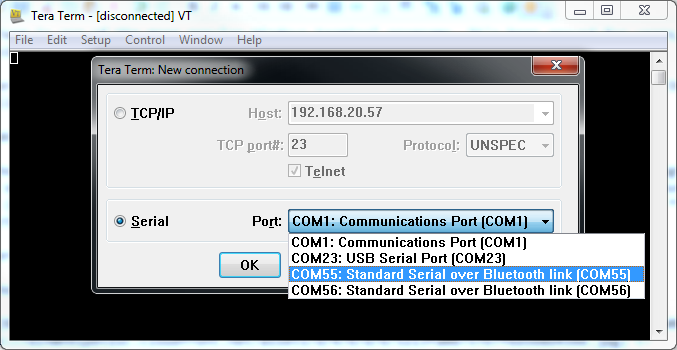
Select the 'Serial' radio button and choose the 'mbed Serial Port' from the drop down menu. Click 'OK' Setup New-line format (to print out new line characters correctly). Setup - Terminal. Under 'New-line', set Receive to 'LF' Your terminal program is now configured and connected. To change the baud rate, go to Setup - Serial Port.
Mac/Linux Users 1. Install a Terminal Application If you do not already have it, install 2. Setup the Connection. Connect using screen by typing the command screen /dev/ in your console window. To find the device name of your mbed Serial Port, see the Host Interface section.
Teraterm Script Serial Port
To exit screen, press Ctrl-A, then ':quit'.
The serial port (a.k.a. COM-port, or RS232) is slowly disappearing from desktop and laptop computers, but it's still a very important tool for embedded engineers and people controlling equipment in general. Copyright form pa download.
The reason for this is that the serial port is very simple to set-up and use both from embedded software code (the vast majority of MCUs and controllers have UART ports) and from a PC. A few years ago I've written several posts about working with the serial port using Perl and C on a Windows PC.
Tera Term Macro Open Serial Port
Since last year, having moved to Python, I've been happily employing the excellent module to do this. I want to write a couple of posts on combining PySerial with GUIs and dynamic charts, but first I'll have to explain how to set it up. Installing a COM-port emulator As I've mentioned, it's hard to come by a PC with real COM ports these days. Although there are many adapters on the market, the simplest thing to do if all you have is a single computer is installing an emulator. One that I recommend is called. It is simple to install and works pretty well. So, download com0com and follow the installation instructions carefully to create two virtual COM ports which are connected to each other.
For me com0com created ports named CNCA0 and CNCB0 - in future versions the names may be different, but it really doesn't matter. Make sure to read the Q&A section in the README file of com0com. For instance, I had turned on buffer overrun emulation because I didn't want the sender to hang when no receiver is connected at the paired port. At this stage if you're familiar with HyperTerminal, you can check that the ports are indeed working and connected to each other. Import serial from time import sleep port = '.
CNCA0' ser = serial.Serial(port, 38400, timeout= 0) while True: data = ser.read( 9999) if len(data) 0: print 'Got:', data sleep( 0.5) print 'not blocked' ser.close What this does is basically sleep for half a second, and then check if new data has arrived on the serial port. If it has (the length of received data is not 0), the data is printed out. During the loop the receiver keeps printing not blocked to demonstrate that the serial.read call isn't blocking. Not blocked not blocked not blocked not blocked Got: hello not blocked not blocked not blocked The amount of not blocked messages depends on how long the receiver ran before and after you ran the sender. It's worthwhile to learn how to use HyperTerminal if you're working with serial ports. HT is a convenient tool for 'sanity checking' of your computer's ports and the programs you develop to communicate.
Teraterm Macro Serial Port
Note that half of the backslashes are there to quote other backslashes. Using Python's raw strings it's definitely possible to write the port name as r'. CNCB0', but I'm keeping the longer syntax for compatibility with standard notation and C code. I'm not just pulling these out of a sleeve. These settings are the defaults of PySerial. Non-blocking reads are very important in interactive applications - you surely don't want to hang your GUI until a new piece of data arrives on the serial port.