Kiso Suzuki Guitar Serial Numbers
Recently I was stumbling through a flewmarket and when I saw some guitars which I couldn't resist to buy. One of them was a Nagoya Suzuki No. 6 ( Three SSS from Nagoya Suzuki Japan). It looked like someone used it in a war. As a weapon of choice. And I think, whoever used it, didn't sing down the war, but rather hammered it into the heads of his/her enemies. In my head I met thas 20 years old Bum sayin': 'Yo, I need a job!
Or maybe you got a dollar for food, maaahn? Yooo, have been to 'Nam and slayed a lot of enemies with that Nagoya Suzuki No. 6 right from Japan!' When I held it in my hands it felt somehow special. It is pretty nicely crafted and has pretty unique haptics. Also (even though the strings were more rust than anything else) I had the feeling, that one could be able to get some really unique sound from it.
While he wanted 27€ for the Nagoya Suzuki No. 6 from Japan, I gave him 15€. That was rude, wasn't it? He was trying to sell me some really cheap 'crafted' decorative ukuleles (which actually weren't crafted or even decorative) as very special and 'magnificent master instruments'. When I realized, that he just wanted to make cash on any(ones) cost(s), I decided to treat him as unpersonal as I thought he might deserve it. Consider: I might have given him 30€+ gladly on other circumstances.
I gladly pay for what I like. SSS - Vintage - Japan RESTORATION Long story short. I bought it and went home to find out, that this was somewhat like a (personal) little treasure. Unfortunatly I had taken no pictures right after I got it.
REALLY REALLY. Looked horrible. The Suzuki No. 6 was covert by dirt, dust and HATE. After cleaning it, it already started to look nice.
After picking down some laminate and cleaning the frets and other metal parts with 0000-Wool, it already started to shine. I also cleaned the fretboard, as the body and the neck, it also received some rare oils and some secret powers which I transferred via mental aura-power-5000.:)) But first. SOME HISTORY. As far as I know Suzuki started to craft guitars somewhat around 1900. But that is not the start of it's story. As you can read on the web Masakichi Suzuki initiated his 'business' long before.
He was born 1859 and got interested in violins with the age of 14. He was taking the violin of a friend as tool for reverse engineering and hand crafted his first violin after that very example. It was brescian style with slab cut front.
He hired some craftmen and founded Nagoya Suzuki Violin Co. In 1988. After a lot of year in which he did a lot of interesting stuff, like designing machines, he died in the year 1944.
His son Shinichi learned the violin from his sister, studied 8 years in Germany at Klars Klingel, married the German later founded the Suzuki Music School – which is very well known throughout Japan. About 1400 teachers are teaching children between 3 and 10 years in Japan. There are 37 more schools in the world, accomondated by about 300.000 pupils. There are also violin books out there from Suzuki. See some of it.
There is a whole style of playing called after Suzuki. From this wide spreaded experiences, Nagoya Suzuki crafts very good, very affordable, very easy to play violins (and some guitars). Quote: From educational violins to upscale products for advanced-level players, all Suzuki violins produce a better timbre, the longer you use them. The company's quest for improvement will never stop on the way toward the position of 'The World's Best.' After World War II the company split into Kiso Violin Company and the Suzuki Violin Company – later Nagoya Suzuki Violin Company. A note on microeconomics for strategists pdf merge. Both manufactured violins and guitars. Both stopped to produce guitars from 1988/89.
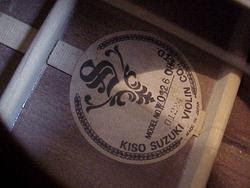
The Nagayo Suzuki Violin Co. Ltd is the one who produced the Suzuki No.6 guitar which this post is dedicated to. My Suzuki No.6 (as most other Nagoya Suzuki guitars) are marked down by a logo of 3 crossing 'S' (The picture above).
How to date a Nagoya Suzuki No. So for now we know, the Suzuki No. 6 must have been produced before 1989. In my case it was build in 1966. It was stamped on the inside. Fortunatly all Nagoya Suzuki Vintage guitars from Japan got a 6 digit stamp inside located at the top/neck.
The first two numbers point out the producing year. 66xxx in my case would mean 1966. Some Nagoya Suzuki guitars miss that feature. You can find a link at the bottom of the post for more clearance on how to date them. There are also some hints on to date other Suzuki labeled guitars.
Just wanna throw in, that there are also cool Kiso Suzuki guitars. There are cool instruments like the Kiso Suzuki 9507 – a sweet Gibson Hummingbird clone, that can sound pretty nice – or the Kiso Suzuki GA-100, the W150 or the 9653. You can finde some more informations on. Same Modell but differently crafted? A user (thanks to Jessica from Germany) contacted me earlier this day - wondering about her Szuzuki No. She has two and wants to sell them.
Because hers was looking slightly diffrently to each other, she contacted me. After a short research I could tell her that one version was from 1972 and had a different headstock and the Bindings do differ too. While all Suzuki No.
6 guitars seem to be made from the same materials, mine also has a white Binding, whilest her 1972 was blackly bindet. Also my Suzuki No.6 has a pretty simple binding around the soundhole, her one was a little more detailled. I thought it was worth to upload her comparison here.
Please do not use these pictures without her permission. If you like to use them, drop me a message and I'll try to contact her and ask for permission. ©Jessica from MA / Germany: Suzuki No.6 Guitar - Nagoya Suzuki SSS Soundhole 1966 Suzuki No.6 Guitar - Nagoya Suzuki SSS Soundhole 1972 Suzuki No.6 Guitar - Nagoya Suzuki SSS Soundhole 1966 Suzuki No.6 Guitar - Nagoya Suzuki SSS Soundhole 1972 Suzuki No.6 Guitar - Nagoya Suzuki SSS Binding Comparison 1966 and 1977 Suzuki No.6 Guitar - Nagoya Suzuki SSS Comparison 1966 and 1977 Pictures of my Nagoya Suzuki No.6 Japan vintage guitar before and after it's (partially) Restoration. This is what it looked like, BEFORE and AFTER the Restoration. Unfortunatly I missed out to take some pictures after I bought it. Also I'm missing some comparison pictures for the Back / Front / Side.
Don't know where they went. But take my word, the front looked like the back and the right side like the left side. Anyway, this is what I got for now. There's a lot more to do. I wanna scrape down and rebuild, or just rebuild the laminate and lower the action a little more. Nevertheless I'm pretty satisfied with my shiny new Nagoya Suzuki No.
6 treasure already. After cleaning and fixing the frets, it already started to sound very lovely. It has a really unique sound. Like a mix betweet a steel stringed koa ukulele and a rusty bucket.
Don't know how to explain it, never had anything sounding so 'funny' and 'interesting' at once. One can create really unique tones with it.
Kiso Suzuki Guitar Serial Numbers
Also it's very lightwighted. Even though (or because of?) the neck i pretty big, you can play it easily. I know it might be a cheap one that may not be worth anything to anyone - except me – but it fills my little GAS-infected heart with joy. Quick Access Wall #2 In any case. This might be one of only a handfull Suzuki No. 6s out there, that is in a decent condition and which is played on a daily base to that.
I at least would be pretty happy If I were that guitar. Like a rescued dog. It got a very nice place on the 'Quick access wall #2' right next to my Framus Sport 51/1 (1955) slideguitar.
Since the Suzuki seems to be from 1966, I thought they might like each other most. Even though it was partially very sophisticated and I had to buy me tools and stuff, I'm glad I saved it from a life of shame. This was actually one of my first works to restore. Started out of and with nothing.
No tools, no knowledge – just google. I actually didn't read a lot tutorials. I much more read about the materials, physics and tools, instead of watching youtube howto's. Well did I talk to some guitar makers and luthiers. Unfortunatly they were pretty 'modern schooled' (some of them didn't even know 'Knochenleim' or 'Bimsmehl' – what a shame). I worked carefully, reasonable and precisely.
And I'm good for now. I think the best rule to keep is: BE PATIENT! I'd like to encourage all readers out there, to save some of this poor guitars and give them a new shiny life. As far as I can say: As older the wood, as prettier the sound. Of course you will have to fix a lot of issues first but in the end, the age seems to matter a lot.
I (and others agree) think my Aria 9400 sounds way better then any original Martin D-28 that has been produced since 2001.